The 5 Biological Laws of German New Medicine, Explained Through Real Life Scenarios
Table of Contents
- The 5 Biological Laws of German New Medicine in Short
- Why the Five Laws Can Feel So Familiar
- The First Law: The Iron Rule
- The Second Law: The Law of Two Phases
- The Third Law: The Ontogenetic System of Tumours
- The Fourth Law: The Ontogenetic System of Microbes
- The Fifth Law: The Quintessence
- How Do the Five Laws Work Together?
- How Can You Use the Five Laws in Everyday Life?
- What Research and Critics Say
- How RootCause Can Help You Reflect
- When to See a Doctor
- Frequently Asked Questions
- Sources and Further Reading
The 5 Biological Laws of German New Medicine in Short
The 5 biological laws of German New Medicine (GNM) are five linked ideas proposed by Dr Ryke Geerd Hamer about how illness begins, unfolds and resolves. They describe illness as the body's response to an unexpected emotional shock, running in two phases and following the embryonic layer each tissue comes from. They are a hypothesis, not established medicine.
| Law | Its name in GNM | What it says in plain words | A real life question it raises |
|---|---|---|---|
| 1 | The Iron Rule | A biological program starts with a sudden, isolating shock | What caught me off guard before this began? |
| 2 | The Law of Two Phases | The program runs in a stress phase, then a repair phase | Did this appear during the hard time, or after it ended? |
| 3 | The Ontogenetic System of Tumours | Tissues respond according to the embryonic germ layer they come from | Does my body react to stress in the same place each time? |
| 4 | The Ontogenetic System of Microbes | Microbes are described as helpers during repair | Do I tend to get unwell just after a stressful stretch? |
| 5 | The Quintessence | Every so-called illness is a meaningful program with a purpose | What might this symptom be trying to help me do? |
Why the Five Laws Can Feel So Familiar
You know the feeling. A message arrives that you did not see coming, your stomach drops, and for days afterwards your body does not feel quite like yours. Then, just as life settles down, you come down with something. Most of us have lived some version of this story, and most of us were told it was a coincidence.
German New Medicine offers a different way to look at that story. This guide walks through each of the five laws slowly, using real life scenarios rather than medical jargon, so you can decide for yourself what is useful to you. We will also be honest about where the laws go further than the evidence, because you deserve the full picture. If you are completely new to the subject, our German New Medicine for beginners guide is a gentle place to start.
The primary source for these laws in English is the LearningGNM library by Caroline Markolin, which RootCause uses as its reference for GNM terms.
The First Law: The Iron Rule
What happens when life catches you off guard?
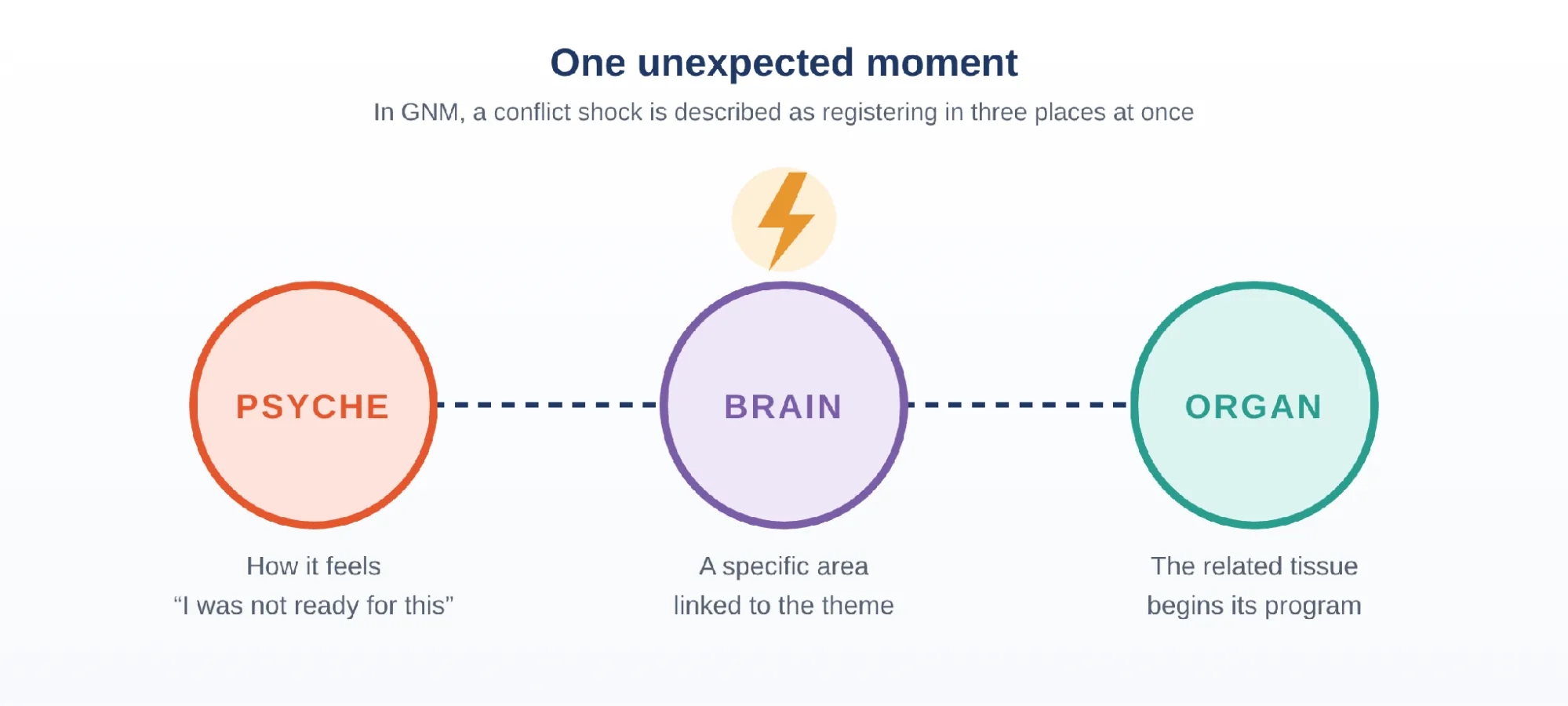
The first law proposes that every so-called disease begins with a specific kind of moment: an unexpected, highly acute and isolating shock. GNM calls this moment a DHS, short for Dirk Hamer Syndrome, named after Hamer's son, whose death in 1978 shaped his thinking. Our history of German New Medicine tells that story in full.
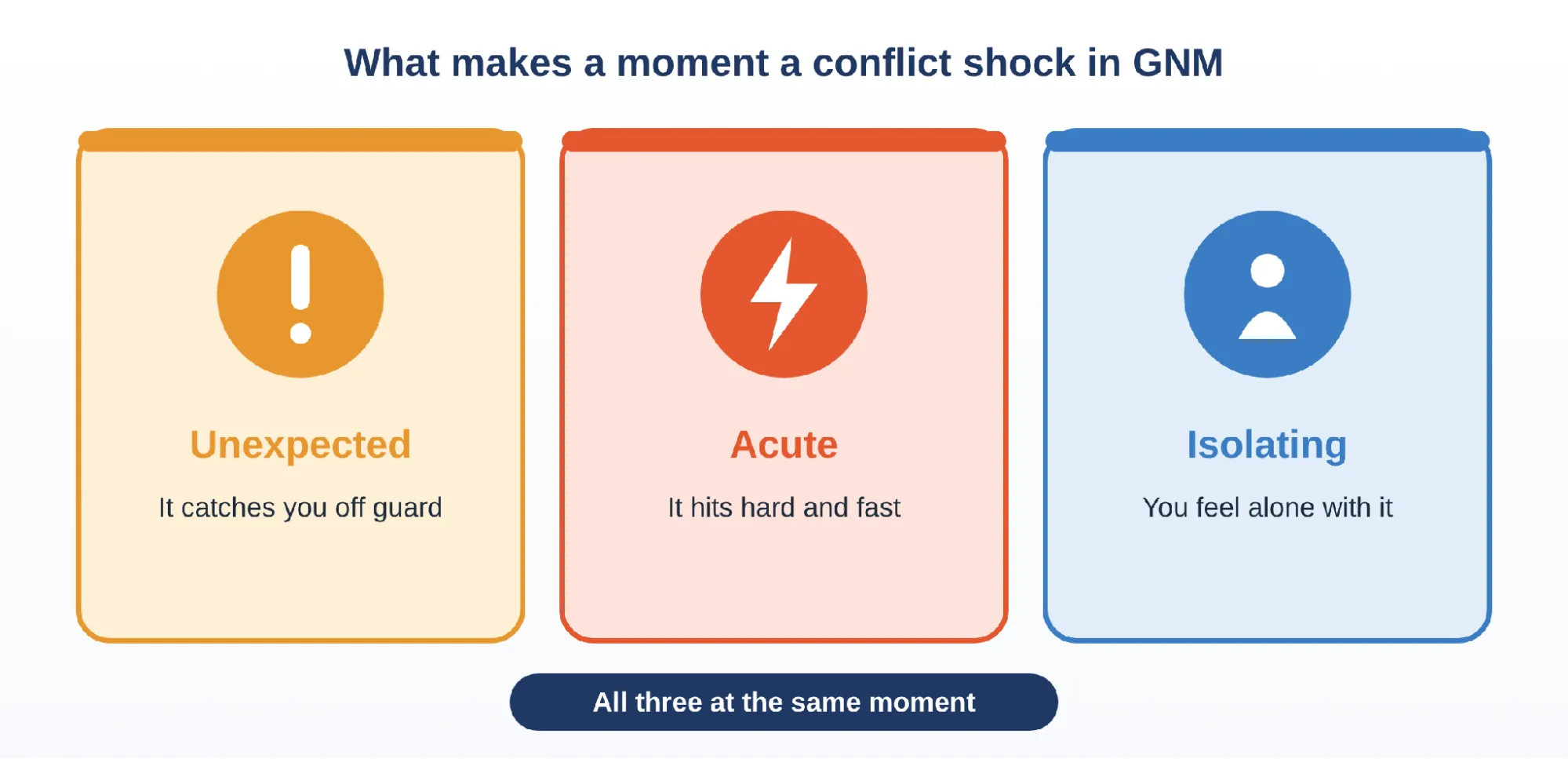
In GNM, not every stressful event counts. Hamer described three qualities that must come together at once.
Unexpected
The moment catches you completely off guard. A redundancy you had been dreading for months is painful, but GNM would say the shock lands in the instant the news arrives in a way you did not anticipate, such as hearing it from a colleague before your manager tells you.
Acute
It hits hard and fast. People often describe a physical jolt: a cold rush, a racing heart, a feeling that time slowed down.
Isolating
You feel alone with it in that moment. Perhaps you could not tell anyone, or you felt that nobody would understand. GNM places great weight on this sense of being on your own with something.
A real life scenario
Imagine someone called Ada. She is at her desk on an ordinary Tuesday when a message from her sister says their father has been taken to hospital. Ada is in a meeting room full of people, she cannot step out, and she cannot talk about it. In GNM terms, that combination of surprise, intensity and isolation is exactly what a conflict shock looks like.
Now compare that with a planned presentation that makes Ada nervous for a week. It is stressful, but it is expected, she prepares for it and she talks it through with friends. In GNM, ordinary stress like this does not start a biological program in the same way.
Mind, brain and body at the same moment
The most unusual claim of the first law is that the shock registers in three places at once: in the psyche as a feeling, in a specific area of the brain, and in a related organ or tissue. Hamer linked the emotional theme of the shock to the organ involved. A shock felt as "I have been separated from someone I love" would, in GNM, relate to different tissue than one felt as "I am not good enough".
What this means in daily life: the first law encourages you to look at timing. Many people find it useful to ask what was happening in the days or weeks before a symptom first appeared. Our guide to how to recognise a conflict shock offers a step by step way to do that gently.
A question to reflect on: Was there a moment, shortly before this started, when I felt surprised, shaken and alone at the same time?
The Second Law: The Law of Two Phases
Why do symptoms sometimes appear after the stress is over?
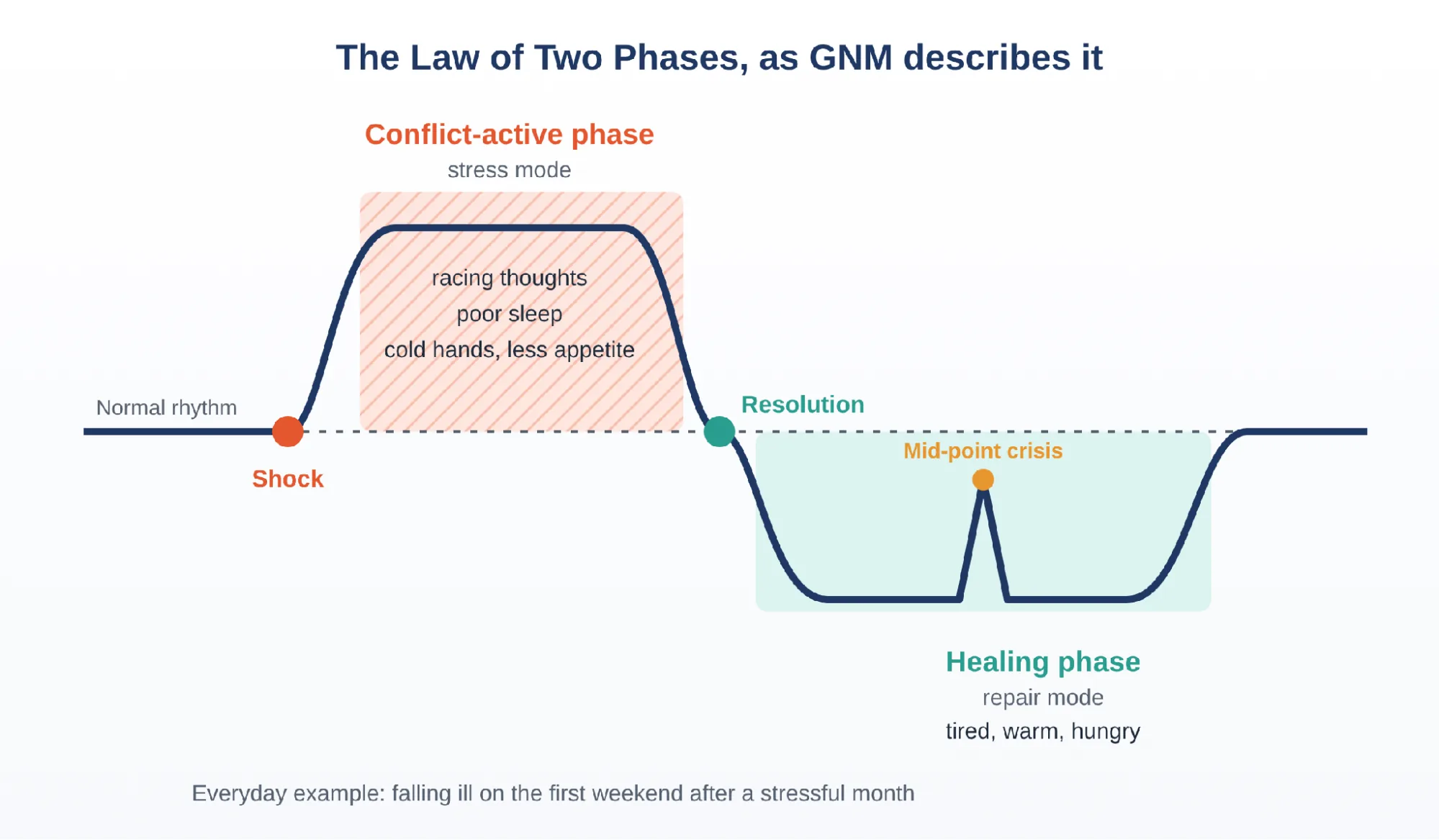
The second law proposes that a biological program runs in two phases, provided the conflict is resolved. First comes a stress phase while the conflict is active. Then, after resolution, comes a repair phase. GNM describes the repair phase as the time when many noticeable symptoms appear.
Phase one: the conflict-active phase
In GNM, the body switches into stress mode, which Hamer called sympathicotonia. He described signs that many people will recognise from difficult weeks:
- thinking about the problem constantly, even at night
- sleeping badly or waking early
- cold hands and feet
- eating less or forgetting meals
- feeling driven, alert and restless
According to GNM, the related tissue is also changing during this phase, often without obvious symptoms.
The turning point: resolution
At some point the conflict resolves. The person returns, the misunderstanding clears up, the job offer arrives, or you simply come to terms with what happened. GNM calls this moment conflictolysis.
Phase two: the healing phase
After resolution, GNM describes the body switching into repair mode, called vagotonia. People often feel tired, warm, heavy and hungry again. In GNM, this is when inflammation, swelling, pain or fever tend to appear, as the tissue repairs. Halfway through, GNM describes a short, intense peak called the epileptoid crisis, after which the body moves towards recovery and its normal day and night rhythm returns.
A real life scenario
Think of Ada again. For three weeks she visits the hospital after work, sleeps badly and barely eats. Her hands are always cold. Then her father comes home and is doing well. That weekend, Ada sleeps for twelve hours, feels exhausted and comes down with a heavy cold and a headache.
Many people say they fall ill at the start of a holiday or right after a big deadline. Mainstream medicine has its own explanations for this, including changes in sleep and the immune system. GNM reads it as the second law in action: the repair phase beginning once the pressure lifts.
Why this matters for how you feel about yourself
One gentle gift of the second law is that it can reduce self-blame. Instead of "I always get sick, my body is weak", it offers a different story: "My body held on while it needed to, and let go when it was safe." Whether or not you accept GNM, that is a kinder way to talk to yourself.
A question to reflect on: Did this symptom show up during the difficult time, or shortly after it eased?
The Third Law: The Ontogenetic System of Tumours
Why would different parts of the body respond in different ways?
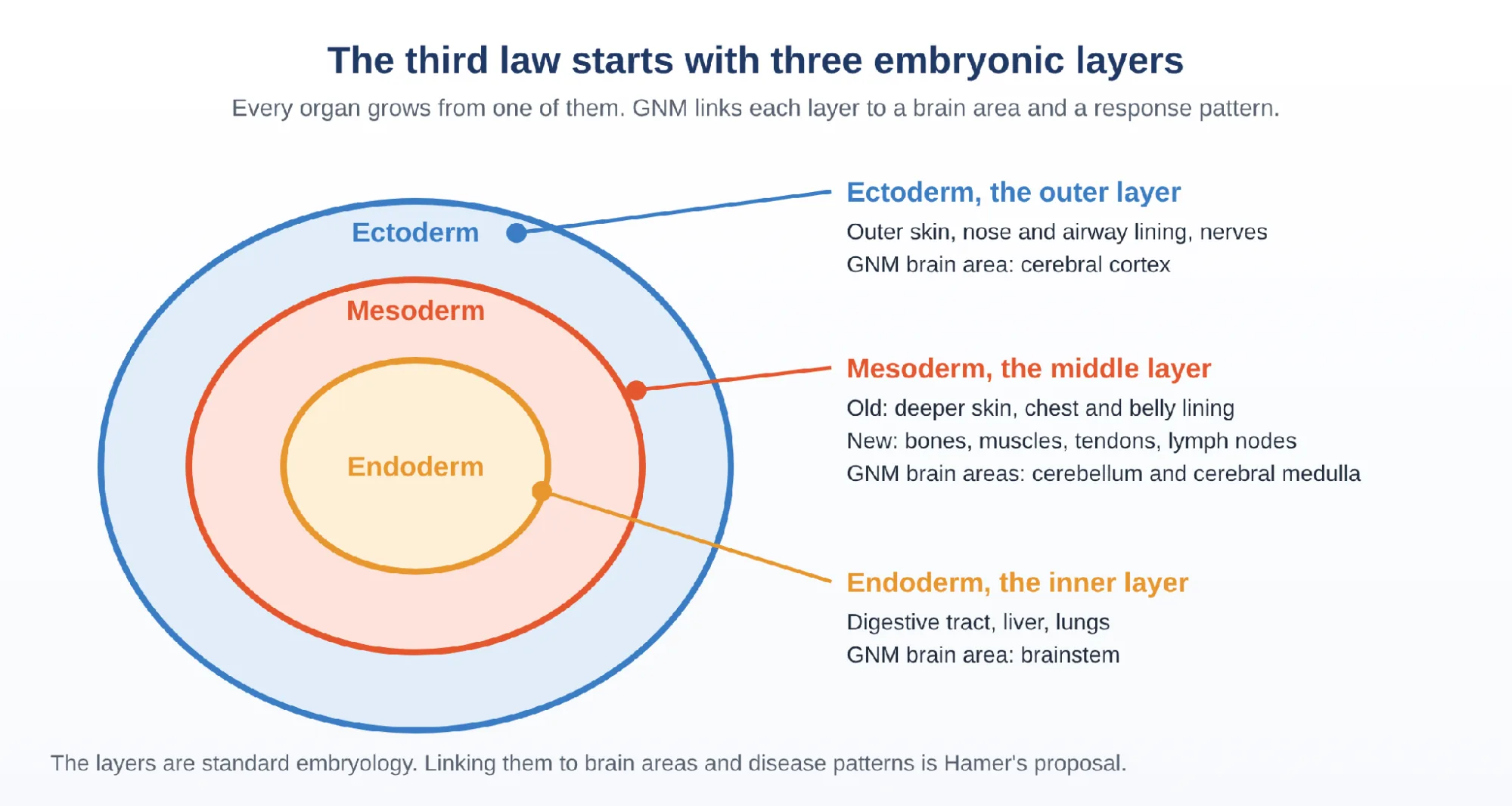
The third law proposes that how a tissue responds to a conflict depends on which embryonic germ layer it developed from. "Ontogenetic" means relating to how an organism develops, and Hamer used it to tie illness patterns to embryology and evolution. In GNM, each germ layer is linked to a brain region, a typical conflict theme and a predictable tissue change in each phase.
What are the three germ layers?
In the first weeks of pregnancy, the embryo organises itself into three layers of cells, and every organ in the body grows from one of them. This part is standard embryology:
- Endoderm, the inner layer, which forms the lining of the digestive tract, the liver, the pancreas and the air sacs of the lungs.
- Mesoderm, the middle layer, which forms muscles, bones, connective tissue, blood vessels and the kidneys.
- Ectoderm, the outer layer, which forms the outer skin, the nervous system and the lining of some passages, such as the nose.
Hamer then added his own step. GNM splits the mesoderm into an "old mesoderm", such as the deeper skin and the linings around the lungs, heart and abdomen, and a "new mesoderm", such as bones, muscles, tendons and lymph nodes. That gives four groups in GNM.
Which brain region does GNM link to each germ layer?
LearningGNM teaches that older germ layers are controlled from older parts of the brain, with the endoderm linked to the brainstem, described as the oldest part of the brain. Each group also carries typical conflict themes in GNM.
| Germ layer | Brain region in GNM | Typical conflict themes in GNM | Example tissues |
|---|---|---|---|
| Endoderm | Brainstem | Survival themes, such as not being able to "digest" a situation (a morsel conflict) or a fear of death | Digestive tract, liver, air sacs of the lungs |
| Old mesoderm | Cerebellum | Attack conflicts, and worry about protecting yourself or someone close | Deeper skin, linings of the chest and abdomen |
| New mesoderm | Cerebral medulla | Self-devaluation conflicts, such as "I am not good enough" | Bones, muscles, tendons, lymph nodes |
| Ectoderm | Cerebral cortex | Separation, territorial and sexual conflicts | Outer skin, nose lining, nerves |
What tissue changes does GNM propose?
GNM divides the brain into the "old brain" (brainstem and cerebellum) and the cerebrum (cerebral medulla and cerebral cortex), and proposes opposite patterns for each:
- Old brain tissues build up cells while the conflict is active. LearningGNM states that for organs controlled by the brainstem and cerebellum, the organ "generates cell proliferation during the conflict-active phase", as if adding capacity to deal with the problem. In the healing phase, the extra cells are broken down.
- Cerebrum tissues lose cells or function while the conflict is active. For tissues controlled by the cerebral medulla and cortex, the same source says the tissue "responds with cell loss". In the healing phase, the tissue is rebuilt, which GNM links to swelling, inflammation and pain.
| Germ layer group | Conflict-active phase in GNM | Healing phase in GNM |
|---|---|---|
| Endoderm (brainstem) | Extra cells build up | Extra cells are broken down |
| Old mesoderm (cerebellum) | Extra cells build up as protection | Extra cells are broken down |
| New mesoderm (cerebral medulla) | Tissue is lost or weakened | Tissue is rebuilt, often with swelling and pain |
| Ectoderm (cerebral cortex) | Tissue thins or function drops | Tissue is restored, often with inflammation |
What are Hamer Foci?
Hamer also claimed that each conflict leaves a visible ring pattern on a brain CT scan, in the exact brain region linked to the tissue. He called these patterns Hamer Foci and saw them as proof of the third law. Radiologists and critics, including Science-Based Medicine, describe these rings as artefacts produced by CT scanners rather than real brain findings.
A real life way to picture it
Imagine a large building when the fire alarm rings. Each department responds in its own way. Security locks the doors, the kitchen turns off the gas, the office team gathers outside. Nobody is malfunctioning; each department follows its own procedure. GNM pictures the body in a similar way: the same kind of shock is met with different responses depending on which "department" the tissue belongs to.
So, in GNM terms, a shock felt as "I cannot digest this situation" relates to the gut, which comes from the endoderm. A shock felt as "I am not good enough" relates to bones and muscles, which come from the new mesoderm. Our guide to biological conflicts behind common illnesses goes through examples such as back pain, skin rashes and digestive trouble.
Where the evidence stands
The germ layers themselves are standard embryology. What is not supported by mainstream research is Hamer's claim that they control fixed disease patterns from specific brain regions, or that conflicts can be seen on brain scans. Treat this law as a map to reflect with, not a diagnosis.
A question to reflect on: When life is hard, does my body tend to react in the same place each time?
The Fourth Law: The Ontogenetic System of Microbes
How does German New Medicine see microbes?
The fourth law proposes that microbes do not cause illness but act as helpers that the brain switches on to support repair. Each type of microbe is said to work on tissues from a particular germ layer. This is the law that departs furthest from established science, so it helps to look at both views side by side.
GNM's interpretation of microbes
According to the LearningGNM text on the five laws, microbes are specialists with fixed jobs:
- Fungi and mycobacteria (including the tuberculosis bacterium) are said to work on tissues from the endoderm and the old mesoderm. In GNM, they multiply from the moment of the conflict and then break down the extra cells that are no longer needed during the healing phase. GNM also says they must already be present before the conflict to do this.
- Other bacteria are said to work mainly on tissues from the new mesoderm, such as bone, multiplying once the conflict resolves and helping to rebuild tissue that was lost. Some are also said to help repair outer tissues, such as the lining of the throat.
- Viruses are described as "hypothetical". The same text states that the existence of viruses that cause viral infections "has never been scientifically substantiated", and suggests that what are called viruses are particles made by the body's own cells.
The text also states that "diseases are not contagious", explaining symptoms in other people as their own healing from a shared conflict.
What established microbiology shows
Mainstream science sees microbes very differently, and the evidence behind that view is extensive:
- Specific microbes cause specific infections. Germ theory has been tested for well over a century, and the microbes behind diseases such as tuberculosis, cholera and pneumonia are identified routinely in laboratories.
- Viruses are real and observable. They can be photographed with electron microscopes, their genetic code can be read, and vaccines are designed from that knowledge.
- Infections spread between people. Contagion can be traced and measured, and handwashing, vaccines and isolation reduce it.
- Treatment saves lives. Antibiotics, antivirals and antifungals cure infections that can otherwise become serious or fatal.
There is one area of overlap worth noting. Microbiology does recognise that many microbes are helpful, such as the bacteria in a healthy gut. What it does not support is the idea that disease-causing microbes are only helpers that the brain switches on. The 2005 academic review of Hamer's system also found the microbe claims unsupported.
| Question | GNM's interpretation | Established microbiology |
|---|---|---|
| Do microbes cause infections? | No, they help repair tissue | Yes, specific microbes cause specific infections |
| Do viruses exist? | Described as hypothetical | Yes, they are imaged, sequenced and studied daily |
| Are diseases contagious? | No, shared symptoms come from a shared conflict | Yes, many infections spread from person to person |
| Should infections be treated? | Microbes are seen as part of healing | Yes, treatment can prevent serious harm |
This is where RootCause draws its firmest line. If you have signs of an infection, such as a fever, a spreading redness or a cough that will not settle, please see a doctor and take any treatment you are prescribed.
What can still be useful in everyday life
You do not need to accept the fourth law to notice its everyday question about timing. If you tend to come down with something just after a stressful stretch ends, that pattern is worth writing down. Research does support a general link between stress and immunity: an APA summary of a meta-analysis of 293 studies reports that long-term stress suppresses many parts of the immune system. Notice the pattern, build in rest at those times, and still treat any infection with proper medical care.
A question to reflect on: Do I tend to get unwell just after a hard period ends, and could I build in more rest at those times?
The Fifth Law: The Quintessence
Could a symptom have a purpose?
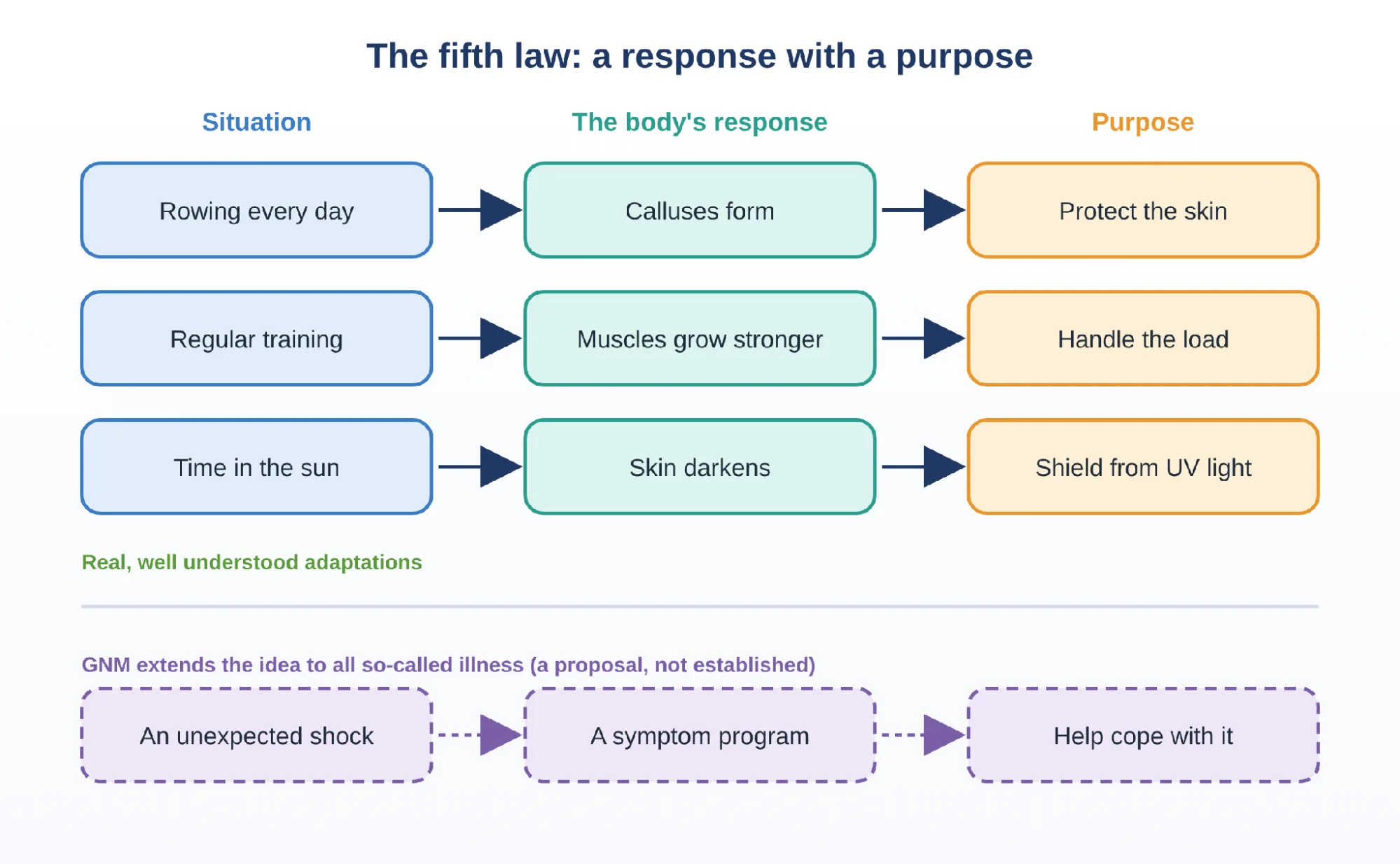
The fifth law, which Hamer called the Quintessence, proposes that every so-called disease is a "Meaningful Biological Special Program of Nature": an ancient survival response that helps the body cope with a specific challenge. In GNM, symptoms are not mistakes but adaptations.
Examples from everyday biology
Some of the body's responses clearly have a purpose. Hands that row every day grow calluses to protect the skin. Muscles that are trained grow stronger. Skin that spends time in the sun darkens to shield itself. These are well understood, real adaptations.
GNM takes this idea much further and applies it to every so-called illness. That extension is Hamer's claim, not an established finding, and it should never be used to delay care for a serious symptom.
Why this law resonates with so many people
Many people with long-running symptoms have been told their tests are normal and there is nothing to find. The fifth law speaks to that experience. It reframes the body as a partner trying to help, rather than an enemy that has failed. As a way of relating to yourself, that shift from "what is wrong with me?" to "what might my body be trying to do?" can feel like relief.
A question to reflect on: If this symptom were trying to help me through something, what might that be?
How Do the Five Laws Work Together?
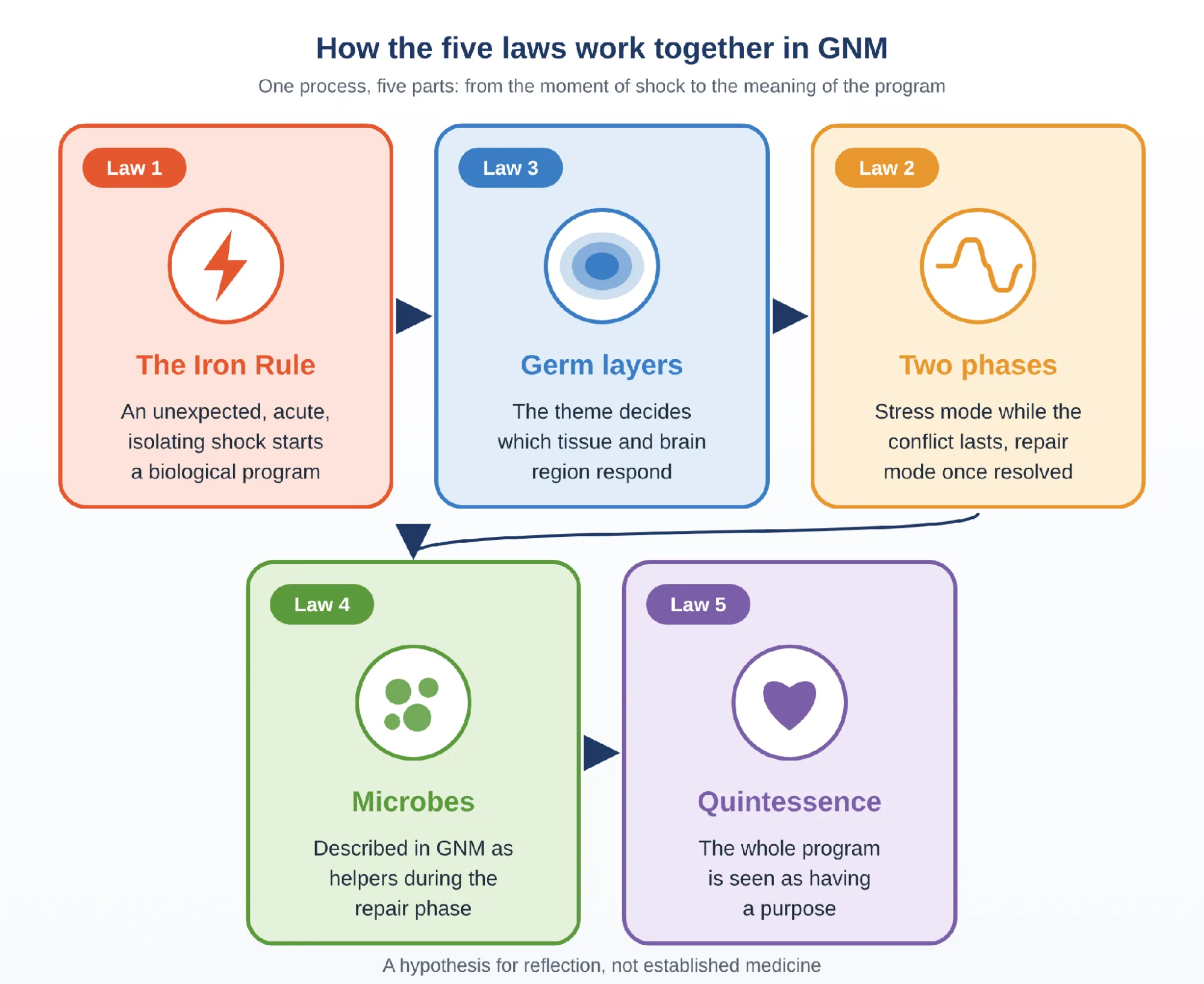
The five laws are meant to work as one system, with each law describing a different part of the same process. The first law explains how a program starts, the third explains where in the body it plays out, the second explains its timing, the fourth explains the role GNM gives to microbes during repair, and the fifth explains why GNM believes the whole program exists.
A real life scenario: Joseph's story
Here is a single hypothetical story, told through all five laws.
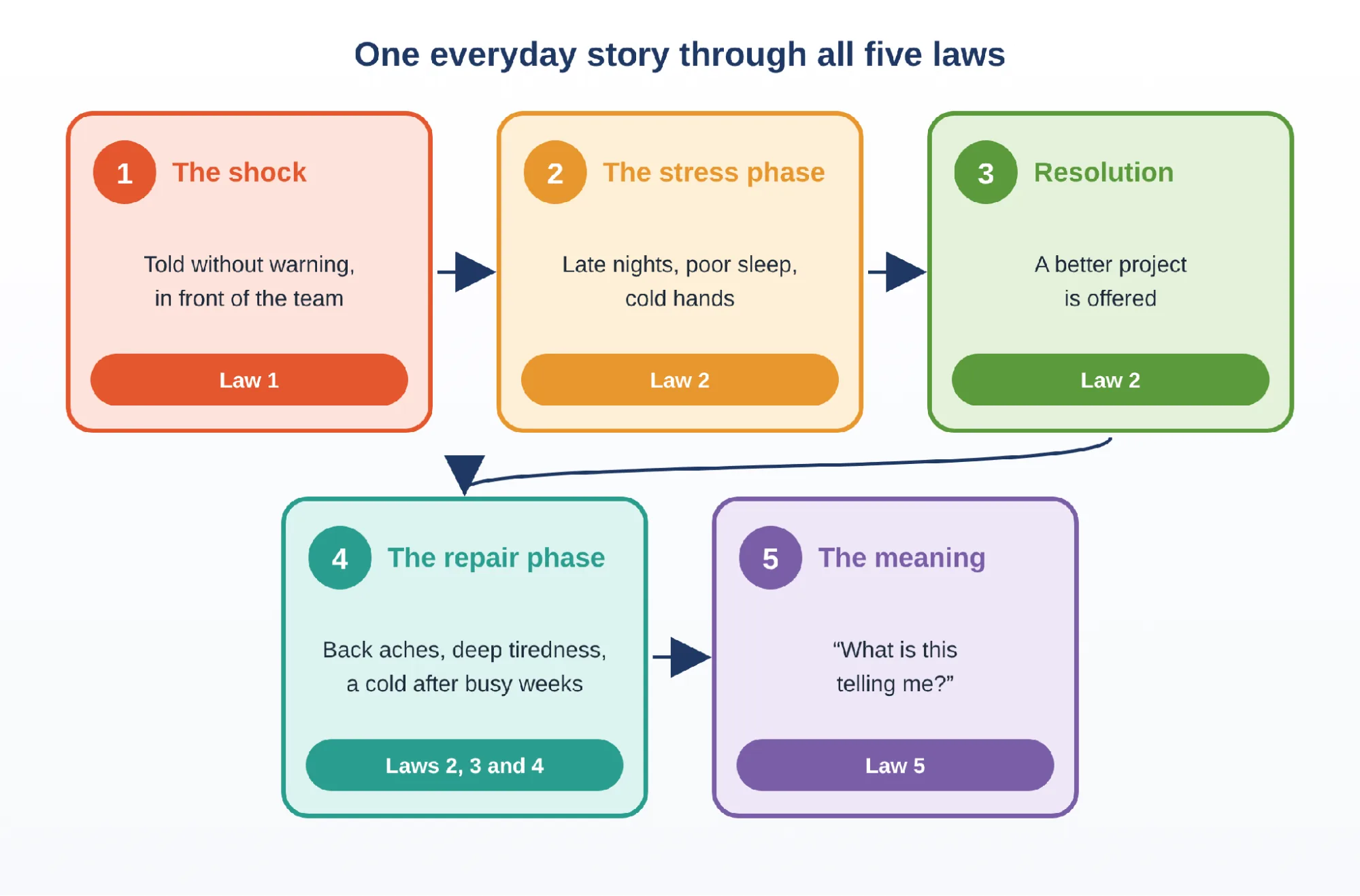
- The shock. Joseph is told, without warning and in front of his team, that his project is being given to someone else. He feels humiliated and has nobody to talk to about it.
- The stress phase. For the next month he works late, sleeps badly and replays the meeting in his head. His hands are often cold.
- The tissue. The theme he felt was "I am not good enough". In GNM, that theme relates to muscles and bones, tissues from the new mesoderm.
- Resolution and repair. He is offered a better project. A week later, his lower back aches and feels swollen, and he is exhausted. In GNM, this is the healing phase.
- Timing and microbes. He notices that he also tends to catch colds right after busy seasons end, and he writes that pattern down.
- Meaning. Joseph asks what the ache might be telling him. He realises he has been measuring his worth by one project, and he decides to talk to his manager about how decisions are communicated.
| Law | Where it appears in Joseph's story |
|---|---|
| 1. The Iron Rule | Being told without warning, in front of others, with nobody to turn to |
| 2. The Law of Two Phases | A month of stress, then an aching back once the better project arrives |
| 3. The Ontogenetic System of Tumours | A self-worth theme, linked in GNM to bones and muscles |
| 4. The Ontogenetic System of Microbes | Colds that tend to arrive just after busy seasons end |
| 5. The Quintessence | Asking what the symptom might be pointing him towards |
Throughout this story, Joseph also sees his doctor about his back, because persistent back pain deserves a proper check. Reflection and medical care sit side by side.
How Can You Use the Five Laws in Everyday Life?
The most helpful way to use the five laws is as a structured habit of noticing, not as a way to diagnose yourself. The steps below keep the reflection curious, kind and safe.
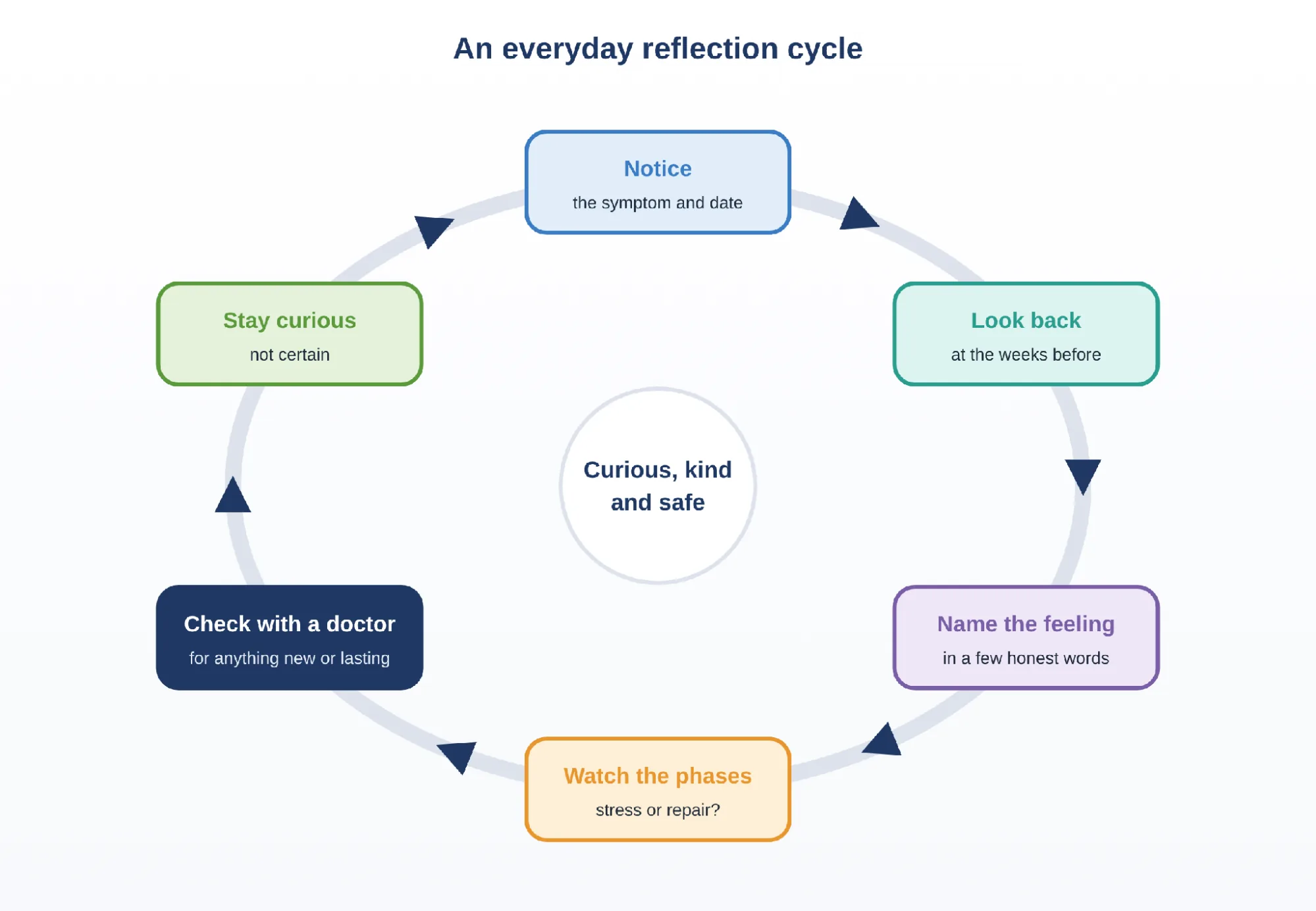
- Notice. Write down a symptom when it appears or changes, with the date.
- Look back. Ask what happened in the days and weeks before it started.
- Name the feeling. Describe how a key moment felt in a few honest words, such as "left out", "attacked" or "not good enough". Our guide to the emotional causes of illness in German New Medicine lists common themes.
- Watch the phases. Notice whether symptoms come during stressful periods or after they ease.
- Check with a doctor. Get any new, severe or lasting symptom properly assessed.
- Stay curious, not certain. Hold your ideas lightly. Hindsight can make links look stronger than they are, and nobody causes their own illness by failing to resolve a feeling.
What Research and Critics Say
GNM is not accepted by mainstream medicine, and it is important to understand why. Hamer lost his medical licence in 1986 and was later convicted in Germany and France, as the Wikipedia entry on Ryke Geerd Hamer records. Critics, including Science-Based Medicine, argue that the laws cannot be tested, that the brain findings Hamer described are imaging artefacts, and that patients have been harmed when they turned away from effective cancer treatment.
The picture is not entirely one-sided. The 2005 review of Hamer's system found that the first two principles, about emotional shocks and the body's stress and recovery responses, sit comfortably within holistic thinking, while the claims about microbes and metastasis were unsupported. Separate research also shows that stress and difficult life experiences affect physical health. The CDC reports that about 61 percent of adults have had at least one adverse childhood experience, and that these experiences are linked to several leading causes of death.
That research supports the broad idea that emotional life and physical health are connected. It does not prove GNM's specific laws. RootCause uses the laws as a reflective framework for that reason.
How RootCause Can Help You Reflect
RootCause helps you notice patterns between your symptoms and your emotional life, using the five laws as a lens for reflection alongside your medical care. You can start with a free symptom report and keep a timeline of how you feel over time. RootCause is available on the App Store and Google Play.
When to See a Doctor
Please see a doctor for any symptom that is new, severe, lasting or getting worse, and seek urgent help in an emergency. Keep taking any treatment you have been prescribed. Reflecting on your emotional life can sit alongside medical care, but it should never replace a diagnosis, a test or a treatment.
Frequently Asked Questions
What are the five biological laws of German New Medicine?
They are five ideas proposed by Dr Ryke Geerd Hamer. Illness starts with an unexpected, isolating shock (the Iron Rule). It runs in a stress phase and a repair phase (Two Phases). Tissues respond according to their embryonic germ layer. Microbes act as helpers during repair. Every so-called illness has a purpose. They are a framework, not established medicine.
Who developed the five biological laws?
The five biological laws were developed by Dr Ryke Geerd Hamer, a German physician, after the death of his son Dirk in 1978 and his own cancer diagnosis. He first presented his ideas in 1981 and later called the system German New Medicine. Hamer lost his medical licence in 1986 and died in Norway in 2017.
What is the first biological law?
The first biological law, called the Iron Rule, proposes that every so-called disease begins with a DHS: an unexpected, highly acute and isolating conflict shock. GNM says this shock registers at the same moment in the psyche, in a specific brain region and in a related organ, and that the emotional theme of the shock decides which tissue responds.
What is the difference between the conflict-active and healing phases?
In GNM, the conflict-active phase is a stress mode that begins with the shock, with racing thoughts, poor sleep and cold hands. The healing phase begins once the conflict is resolved and is a repair mode, with tiredness, warmth and often inflammation, swelling or pain. GNM describes a short mid-point crisis before recovery.
What are the three germ layers in German New Medicine?
The three germ layers are the endoderm (inner layer), the mesoderm (middle layer) and the ectoderm (outer layer), from which every organ develops. GNM splits the mesoderm into old and new, and links each group to a brain region: brainstem, cerebellum, cerebral medulla and cerebral cortex. The layers are real embryology; the brain links are Hamer's proposal.
What is the role of microbes in German New Medicine?
GNM teaches that microbes do not cause illness but help repair tissue in the healing phase: fungi and mycobacteria break down extra cells, and other bacteria help rebuild tissue. GNM describes viruses as hypothetical and says diseases are not contagious. Established microbiology contradicts these claims, so infections should always be checked and treated by a doctor.
What does the fifth biological law mean?
The fifth law, the Quintessence, proposes that every so-called disease is a "Meaningful Biological Special Program of Nature" with a survival purpose. It invites you to ask what a symptom might be trying to help you do. Some bodily responses, such as calluses, clearly have a purpose, but extending this to every illness is Hamer's claim, not established science.
Are the five biological laws scientifically proven?
No. The five biological laws have not been confirmed by mainstream research, and the claims about microbes, viruses and brain scans contradict established science. Research does show that stress and adversity affect physical health, which supports a general mind and body connection, but that is not the same as proving GNM. Use the laws for reflection only.
Can the five biological laws replace medical treatment?
No. The laws can help you reflect on what was happening in your life when a symptom began, but they cannot diagnose or treat anything. Keep seeing your doctor, keep taking prescribed treatment, and get any new, severe or lasting symptom checked. Reflection works best alongside medical care.
How does RootCause use the five biological laws?
RootCause uses the laws as a reflective framework to help you notice links between symptoms and life events over time. It does not diagnose, treat or promise outcomes. It is designed to be used alongside your medical care, as a calm space to understand your own patterns.
Sources and Further Reading
- The Five Biological Laws, LearningGNM: the main English reference for GNM terms, including the third and fourth laws.
- The Five Biological Laws of the New Medicine (PDF), LearningGNM: the full text by Caroline Markolin.
- The Five Biological Laws: Introduction, LearningGNM: the hub page for the laws and related documents.
- Introduction to the Five Biological Laws (video), Caroline Markolin: a 60 minute spoken introduction.
- Amici di Dirk: the publisher of Hamer's own books.
- Rationality and Irrationality in Ryke Geerd Hamer's System (2005): an academic review with a mixed verdict.
- The "Iron Rule of Cancer", Science-Based Medicine: a detailed critical evaluation.
- Ryke Geerd Hamer, Wikipedia: an independent overview of Hamer's life and legal history.
- Stress Affects Immunity, American Psychological Association: a summary of research on stress and the immune system.
- Adverse Childhood Experiences, CDC: public health data on early adversity and later health.